For a solid timber front door, a mortice lock is the better starting choice over a standalone deadbolt. Its body embeds inside the door itself rather than sitting on the surface, which gives it more structural strength against forced entry. A deadbolt earns its place as a strong secondary lock or as the main lock on doors where mortice routing isn’t practical.
- Choose a mortice lock for: solid timber front doors, high-traffic entries, doors needing a combined latch and deadbolt in one body.
- Choose a deadbolt for: UPVC, composite or thinner doors, retrofit jobs, or as a second lock layered with a mortice.
Key Takeaways
A mortice lock generally outperforms a standalone deadbolt on solid timber front doors, but a multipoint system usually beats both on UPVC and composite doors.
| Point | Details |
|---|---|
| Mortice suits solid timber | Its embedded body and longer bolt throw give better resistance to kicking and prying. |
| Deadbolt suits retrofits | Faster to fit with less structural change, good for UPVC, composite or secondary locking. |
| Frame strength matters most | A reinforced strike plate often improves security more than switching lock types. |
| Multipoint wins on modern doors | UPVC and composite doors benefit more from multipoint locking than a single-point lock. |
| Easterndoors builds the full solution | Custom security doors from Easterndoors pair the door, lock and reinforcement as one project. |
Table of Contents
- How a mortice lock and a deadbolt actually work
- Which resists forced entry better?
- What variants and terms should you know?
- Will it fit your door?
- How much does each option cost to buy and keep?
- A simple checklist before you decide
- Why multipoint locking often beats a single lock upgrade
- Get a door built around the right lock, not the other way round
- Frequently asked questions
- Sources
How a mortice lock and a deadbolt actually work
A mortice lock sits inside a rectangular pocket cut into the door’s edge, so the whole mechanism is embedded in the timber rather than bolted to its face. Many mortice locks combine a spring latch and a deadbolt in a single body, and the two main residential types are the mortice deadlock and the sashlock.
A deadbolt, by contrast, is a single-point lock. One bolt extends from a cylinder mounted through a bored hole in the door face into a matching hole in the frame. It comes as single-cylinder (key one side, thumb-turn the other) or double-cylinder (key both sides).
- Mortice locks generally have a longer bolt throw and an integrated body, which contributes to greater resistance to forced separation than a typical deadbolt.
- A deadbolt’s bolt sits proud of the door face, mounted through a bore rather than recessed into the door’s core.
- Picture a cross-section of each door edge: the mortice lock disappears entirely into a pocket in the timber, while the deadbolt’s cylinder punches straight through from face to face.
Which resists forced entry better?
On a solid timber door, a mortice lock generally outperforms a standalone deadbolt against kicking and prying, largely because its body is embedded across the full thickness of the door rather than anchored at a single bore point. That embedded design, combining a latch and deadbolt in one mechanism, spreads impact force differently than a single cylinder punched through the door face.
That said, cylinder quality matters more than lock type alone. Cheap euro cylinders on either lock style are vulnerable to snapping, drilling, or picking, so an anti-snap or anti-drill rated cylinder closes that gap regardless of which body you choose.
- Kicking and prying: mortice locks generally hold up better due to full-depth embedding.
- Picking and drilling: comes down to cylinder quality, not lock type.
- Cylinder snap: mainly a euro-cylinder risk on deadbolts and some mortice cylinder variants.
The lock is rarely the actual weak point. Industry guidance consistently points to the door frame and strike plate as the part that fails first under a solid kick.
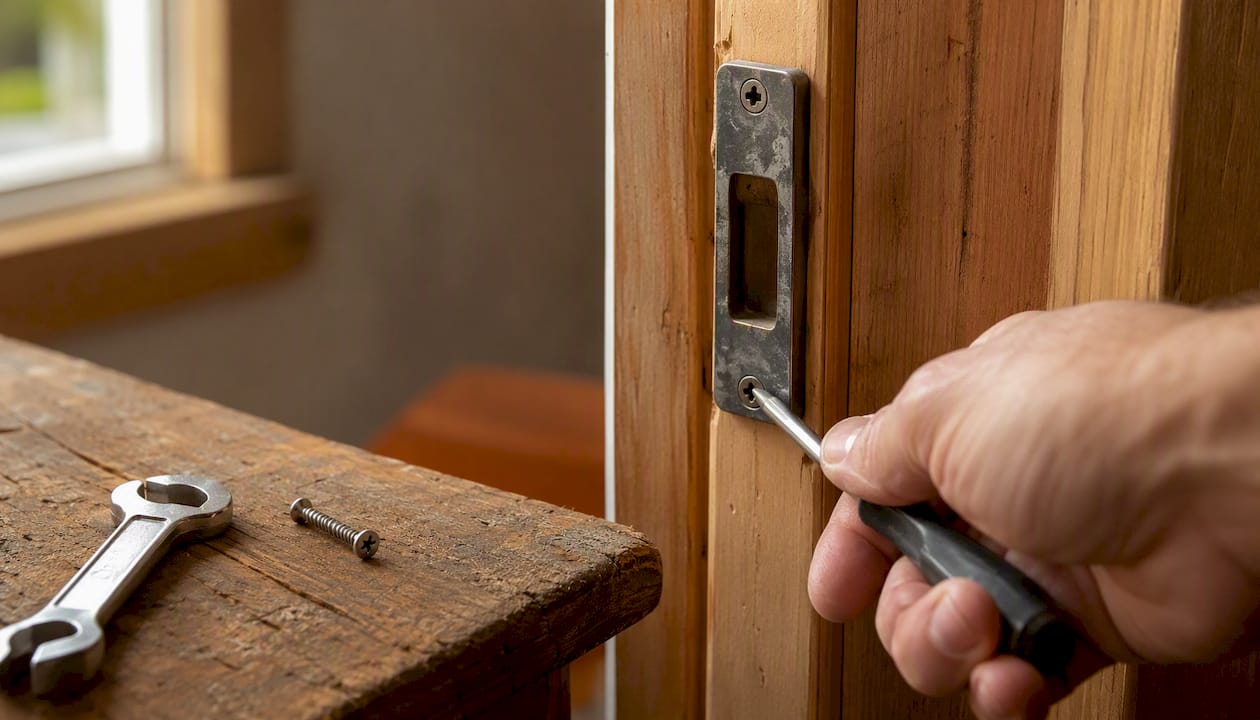
Pro Tip: A $40 lock upgrade means nothing if the strike plate is still held in with 20mm screws. Fit a reinforced strike plate with 65mm screws that bite into the frame’s structural timber, and pair your main lock with a secondary deadbolt for layered defence.
What variants and terms should you know?
Not all mortice locks or deadbolts are built the same, and the labels matter when you’re comparing quotes.
- Mortice deadlock: deadbolt only, no handle or latch, commonly used as a secondary lock on a front door.
- Sashlock: combines a latch (for the handle) and a deadbolt in one body, the standard choice for a main timber entry door.
- Commercial mortice locks: heavier-duty bodies rated for higher traffic, used in shared or rental properties.
- Single-cylinder deadbolt: keyed outside, thumb-turn inside, the common residential choice.
- Double-cylinder deadbolt: keyed both sides, useful near glazing but a fire-egress risk if the key isn’t kept nearby.
- Bolt throw: how far the bolt extends into the frame; longer is generally more resistant to prying.
- Anti-snap / anti-drill cylinders: reinforced cylinder types designed to resist the two most common cylinder attacks.
A double-cylinder deadbolt suits a door with a sidelight window someone could smash and reach through, while a sashlock suits any solid timber front door needing handle and lock in one unit.
Will it fit your door?
Solid timber doors, particularly thicker ones, suit mortice locks best because there’s enough material to rout a clean, structurally sound pocket. UPVC, composite and thinner timber doors generally suit a deadbolt or a factory-fitted multipoint system instead, since routing a mortice pocket into a UPVC profile isn’t practical.
- Mortice fitting means cutting a rectangular recess into the door’s edge, a job that needs precision to avoid weakening the door.
- Deadbolt fitting means boring a hole through the face and a matching hole in the frame, generally a faster job with less structural risk.
- Door material, frame condition and proximity to glazing all affect which lock makes sense. A tired frame won’t hold either lock securely without reinforcement.
- Hire a licensed locksmith for mortice work on an existing door. Retrofitting a deadbolt is more forgiving for a competent installer, but get professional input if the door is UPVC or composite, where lock and door hardware need to match precisely, similar to the compatibility issues covered in this door replacement guide.
If you’re weighing up a full lock swap, our guide to security door lock replacement walks through what’s involved before you commit.
How much does each option cost to buy and keep?
Deadbolts are generally cheaper to buy and quicker to fit, since there’s no routing involved. Mortice locks cost more up front and installation runs higher too, because cutting a clean pocket takes more of a locksmith’s time.
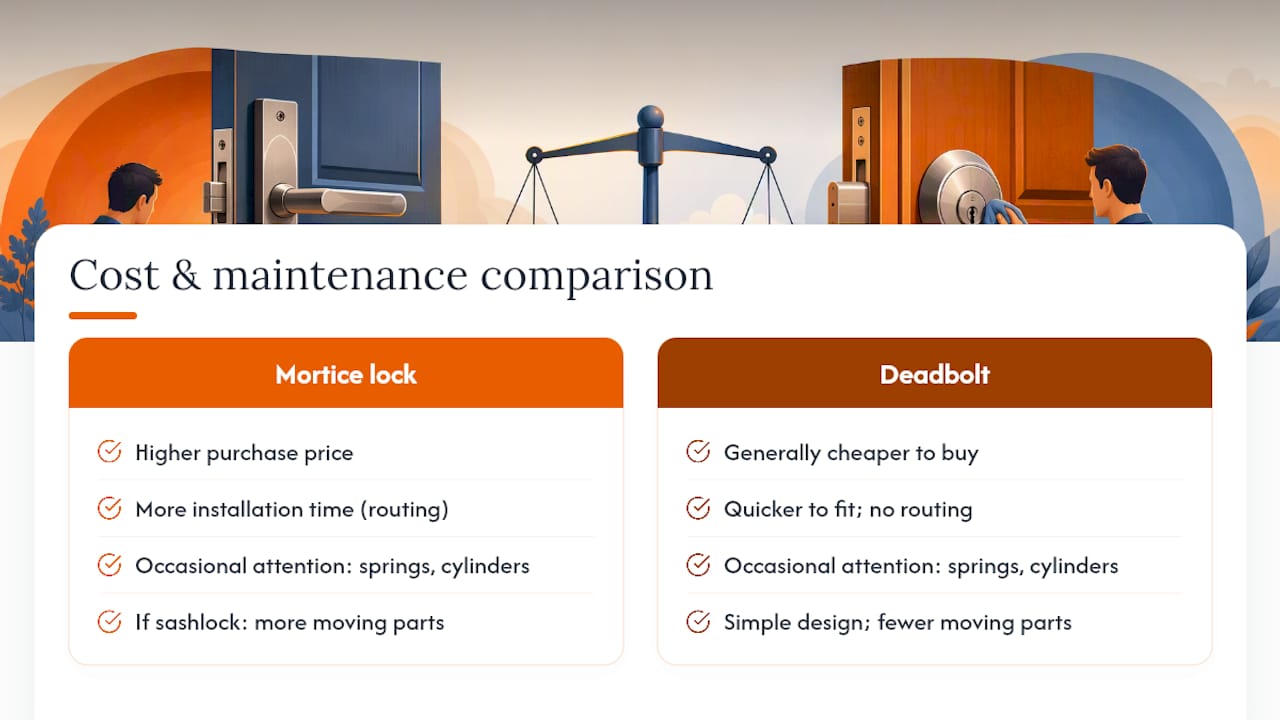
On upkeep, both need occasional attention: springs wear, cylinders eventually need replacing, and euro cylinders in particular vary a lot in quality. A sashlock combining latch and deadbolt has more moving parts than a simple deadbolt, which can mean slightly more to service over time.
Pro Tip: Before buying, ask whether replacement cylinders and springs for that exact lock model are still stocked locally. A lock that can’t be serviced in five years is a false economy no matter how cheap it looked on the shelf.
A simple checklist before you decide
- What’s your door made from, timber, UPVC, composite or steel, and how thick is it?
- What’s actually at risk, a low-traffic side door or your main entry point?
- Does your home insurance specify a lock standard or cylinder rating?
- What’s your budget for supply and professional installation combined?
- Does the lock need to match existing door hardware or a specific finish?
Take these to your locksmith:
- Is this lock compatible with my door material and thickness?
- What’s the bolt throw, and is the cylinder anti-snap and anti-drill rated?
- Will the strike plate need reinforcing as part of this job?
- If my door is UPVC or composite, would a multipoint system serve me better than a single lock swap?
Sometimes the honest answer isn’t a new lock at all. If your door itself is thin, cracked, or the frame is failing, upgrading to a proper security door solves the problem a new lock can’t.
Why multipoint locking often beats a single lock upgrade
For UPVC and composite doors specifically, a multipoint locking system is usually the smarter upgrade over either a bolted-on deadbolt or an attempted mortice retrofit. Multipoint systems engage the frame at several points up and down the door, which spreads load and resists the leverage attacks that a single-point lock can’t counter on the same door type.
The case for stronger door security generally has weight behind it too: the Australian Bureau of Statistics reported break-ins rose after a previous record low, a reminder that entry-point security is worth getting right the first time.
Pro Tip: Multipoint locking only performs as promised when the strike keeps are properly reinforced and the door is professionally installed, not squeezed into an out-of-square frame.
An installer’s perspective
On the tools, the rule of thumb holds up: mortice locks for solid timber front doors, multipoint systems for UPVC and composite, and a deadbolt as a solid secondary lock rather than the sole line of defence. Frame and strike plate condition decides more real-world outcomes than the lock badge ever does.
Get a door built around the right lock, not the other way round
Choosing between a mortice lock and a deadbolt only gets you halfway if the door and frame underneath aren’t up to the job. Easterndoors builds that door-plus-lock solution as one project, custom-measuring your opening and fitting hardware engineered to work with the door, not bolted on as an afterthought.
- Guaranteed fit, since the door and lock are measured and manufactured together.
- Integrated security hardware, so bolt throw, cylinder rating and strike plate all match the door’s construction.
- Professional reinforcement of frame and strike points as part of the install, not an optional extra.
Whether you need a solid steel entry door, a stainless option for a coastal property, or something lighter that still holds up, our range of aluminium, steel and stainless security doors covers it. Book a measure-and-quote and get a turnaround timeline and warranty details specific to your door.
Frequently asked questions
Is a mortice lock more secure than a deadbolt?
On a solid timber door, generally yes, because its body embeds into the door rather than sitting on the surface. On UPVC or composite doors, a multipoint system usually beats both.
Can I fit a mortice lock to a UPVC door?
Not practically. UPVC doors don’t have solid timber to rout a mortice pocket into, so they’re built for bore-mounted deadbolts or multipoint systems instead.
Should I use a mortice lock and a deadbolt together?
Yes, this is a common layered-defence setup for high-risk front doors. A mortice sashlock as the main lock plus a secondary deadbolt gives two separate points of failure for an intruder to overcome.
Is a double-cylinder deadbolt a good idea?
It helps near glazed doors where someone could smash glass and reach the thumb-turn, but keep a key accessible inside for fire egress.
How do I know if my door needs a full upgrade instead of a new lock?
If the door itself is thin, damaged, or the frame is failing, no lock will fix that. A custom security door addresses the door, frame and lock together.
Sources
- Break-ins increase after record low | ABS media release
- 6 types of door locks that will keep your home secure | ArchiPro
- What is a mortice lock? When and where to use them | John Barnes Group
- Multipoint lock kit (product page) | AMSTimber
- A hardware pro’s guide to mortise vs non-mortise lock | Doors For Pros
Recommended
- Security door lock replacement: Australia’s top options in 2026 | Eastern Security Doors
- Choosing the Right Security Door For Your Home
- SecureView vs Crimsafe: which screen wins in 2026? | Eastern Security Doors
- Should You Install a New Security Door or Powder Coat an Existing One? | Eastern Security Doors