For most coastal and high-humidity properties, 316 marine-grade woven stainless steel security mesh is the strongest all-round choice you can specify. It resists salt corrosion better than any other mesh grade on the market, holds up to sustained physical attack, and keeps its strength for decades rather than years.
- Corrosion resistance that survives salt spray, humidity and coastal air without pitting.
- High tensile strength that resists cutting, prying and sustained force.
- Proven performance backed by manufacturer testing rather than marketing claims alone.
If your property sits inland with low humidity, 304 stainless mesh is a reasonable, cheaper alternative. Either way, get a certified installer out to measure and quote before you commit to a product.
Key Takeaways
316 marine-grade woven stainless steel outperforms 304 in coastal and humid environments because its molybdenum content resists chloride corrosion far longer.
| Point | Details |
|---|---|
| Choose grade by exposure | Use 316 near the coast or in humid areas; 304 suits dry inland properties on a budget. |
| Check the real specs | Ask for wire diameter, mesh count, and open area percentage before comparing quotes. |
| Test claims need proof | Request salt spray, impact, or shear test reports rather than accepting marketing language. |
| Bonded frames outlast dry-fit panels | Permanently bonded mesh avoids the plastic retention points that fail under stress. |
| Custom manufacture reduces weak points | Eastern Security Doors measures, builds, and installs to your exact opening with warranty backing. |
Table of Contents
- What is stainless steel security mesh?
- 316 versus 304: which stainless grade do you need?
- Mesh construction and the specs that actually matter
- How stainless mesh holds up under real-world pressure
- Choosing the right mesh: a practical checklist
- Looking after your mesh: maintenance and expected lifespan
- Why custom-made security screens beat off-the-shelf panels
- What years of fitting security screens teaches you
- Get a proper measure and quote for your home
- Where to check datasheets and test claims
- Frequently asked questions
- Sources
What is stainless steel security mesh?
Stainless steel security mesh is woven wire mesh fitted into security doors and screens to stop forced entry while still letting air and light through. It sits somewhere between a flyscreen and a security grille, doing the job of both.
You’ll typically find it used in:
- Window security screens and hinged or sliding security doors.
- Balcony and patio enclosures.
- Bushfire-rated screens, often combined with standard insect protection.
Finish matters more than most homeowners realise. A mill finish gives a raw, slightly reflective look, while a black powder coat cuts glare, improves privacy, and adds an extra layer of corrosion protection on top of the steel itself.
316 versus 304: which stainless grade do you need?
The grade stamped on a datasheet tells you almost everything about how long the mesh will last on your home. Here’s how the two most common options stack up.
| Grade | Corrosion resistance | Typical use case | Cost note |
|---|---|---|---|
| 316 (marine grade) | Excellent, resists salt spray and chlorides | Coastal homes, pools, high-humidity climates | Higher upfront cost |
| 304 | Good, but vulnerable to chloride pitting over time | Inland properties, dry climates, budget renovations | Lower cost, widely stocked |
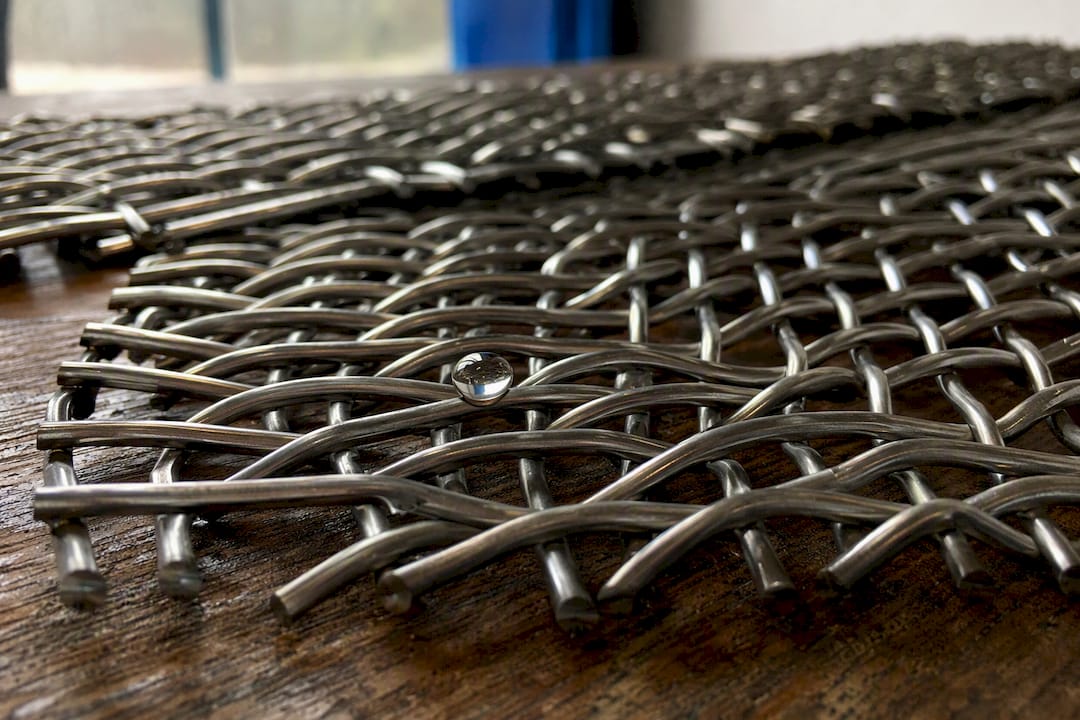
316 earns the “marine grade” label because it contains molybdenum, an alloying element that dramatically improves resistance to chloride attack, the process that eats through cheaper metals near the coast. A supplier offering 316 mesh at 0.80mm wire diameter with an 11×11 weave count is describing exactly the spec you want for a beachside home.
Pro Tip: If you’re more than a few kilometres inland with no salt exposure, 304 mesh can save you money without a meaningful drop in day-to-day security. Save the 316 upgrade for genuinely coastal or humid sites.
Mesh construction and the specs that actually matter
Not all stainless mesh is built the same way, and construction type changes how it performs. Woven mesh, where wires are interlaced under tension, is the standard for security screens because it balances strength with visibility. Knitted mesh flexes more and suits curved applications. Perforated and welded mesh trade some visibility and airflow for a more rigid, plate-like structure, often used in heavier-duty settings.
When you’re comparing supplier datasheets, three numbers tell you almost everything:
- Wire diameter (measured in millimetres) determines raw strength; thicker wire resists cutting better.
- Mesh count (e.g. 11×11) describes how many wires run per inch in each direction, affecting both strength and visibility.
- Open area percentage tells you how much airflow and light the mesh actually allows.
That combination, similar to the spec used in the SECURIT-E bonded system, delivers a tight aperture of around 1.5mm by 1.5mm, small enough to stop a blade being worked through the weave.
How stainless mesh holds up under real-world pressure
Security mesh earns its keep through a few measurable performance traits, not just brand reputation. Tensile strength (how much pulling force the wire withstands before breaking) and shear resistance (how well it resists a blade being dragged across the weave) are the two figures worth asking suppliers about directly. Some 316 marine-grade products have tensile strengths rated in the range typically cited by manufacturers, a range that puts genuine resistance behind a knife or screwdriver attack.
Corrosion testing tells the other half of the story. Neutral salt spray testing exposes mesh to a controlled saline mist over an extended period, and 316’s molybdenum content is what lets it outlast 304 in that environment by a wide margin.
- Dynamic impact and knife-shear tests indicate resistance to forced, physical attack.
- Salt spray results indicate how long a coastal installation will resist visible corrosion.
- Specialised products cover pet-resistant reinforcement, bushfire-rated meshes, and combined pool safety and fire resistance testing where those standards apply to your property.
If a supplier claims a specific certification, ask for the test report or certificate number rather than accepting the marketing copy at face value.
Choosing the right mesh: a practical checklist
Matching mesh to your property comes down to five decisions, and getting them right up front saves you from a costly reinstall later.
- Site exposure: coastal or high-humidity sites need 316; dry inland sites can usually run on 304.
- Opening type: doors see more physical contact and flexing than fixed window screens, so specify accordingly.
- Visibility needs: a finer weave with higher open area suits view-focused areas like living room windows.
- Warranty and testing: ask what corrosion and impact testing backs the product, and what the warranty actually covers.
- Installer certification: professional installation protects both the mesh’s performance and your warranty.
Expect stainless steel security mesh products, fully installed, to sit in a wide price band depending on grade, wire diameter, panel size, coating, and the complexity of the frame. 316 marine grade, powder-coated finishes, and larger door panels all push the price up; standard 304 mesh in smaller window sizes sits at the lower end.
Pro Tip: Retail roll mesh from hardware chains is fine for a quick DIY repair, but for a full security installation, a specialist manufacturer who custom-builds the frame around your openings gives a far more reliable result than adapting a generic panel.
Specialist installers and custom manufacturers remain the better path for genuine security outcomes, with retail rolls reserved for patch repairs or small DIY projects rather than whole-home security. Our guide to window security screens walks through the installation choices in more depth.
Looking after your mesh: maintenance and expected lifespan
Stainless steel mesh is low-maintenance, but “low” doesn’t mean “none.” A simple routine keeps both grades performing as intended.
- Rinse coastal installations with fresh water every few weeks to remove salt build-up before it can settle into the weave.
- Wipe down powder-coated finishes with a mild detergent solution rather than abrasive cleaners.
- Check fastener tension and frame alignment annually, and again after any severe storm.
Under typical Australian conditions, 316 mesh can be expected to outlast 304 by a considerable margin, particularly within a few hundred metres of the coast, where 304 may show early surface pitting. Visible rust spots, a loosening weave, or bowing in the frame are all signs it’s time to call an installer for an inspection rather than wait for a full failure.
Why custom-made security screens beat off-the-shelf panels
A dry-fit panel bought off a shelf is built to a generic size and squeezed into your opening with clips or plastic retainers. That’s where weak points creep in. Eastern Security Doors takes a different approach: every screen starts with a proper on-site measure, so the frame is built to your exact opening rather than adjusted to fit it.
- Professional measurement and consultation before any manufacturing begins.
- Bonded frame options that avoid the plastic retention points common in cheaper dry-fit systems.
- Powder-coated finishes to match your home and add corrosion protection.
- Certified installation backed by manufacturer warranties and ongoing aftercare.
Systems that permanently bond stainless mesh into the aluminium frame, rather than relying on dry-fix plastic retainers, hold their structural integrity far longer under repeated stress and weathering.
That bonded-frame principle, similar to systems like SECURIT-E, is the difference between a screen that stays tight for fifteen years and one that starts rattling within two. Explore the stainless steel door range to see how that construction translates into a finished product.
What years of fitting security screens teaches you
I’ve seen enough coastal properties fitted with the wrong grade to know that saving a few dollars on 304 near saltwater almost always costs more later in premature replacement. The most common mistake isn’t choosing a cheap material outright. It’s homeowners assuming a DIY dry-fit panel will perform the same as a properly bonded, custom-built frame, when the weak point was never the mesh itself.
Get a proper measure and quote for your home
There’s no substitute for a tradesperson standing at your window or door frame with a tape measure, telling you exactly what grade, wire diameter, and finish suit your exposure. Eastern Security Doors builds every screen to the opening, rather than fitting a generic panel and hoping it holds.
That means no gaps at the edges, no plastic retainers under strain, and a bonded frame designed around your home rather than a standard size chart. Our team handles the full process, from consultation and measurement through to manufacture, installation, and aftercare, with warranties that back the workmanship as well as the product. If you’re weighing up your options for windows or doors, browse the range of aluminium, steel and stainless steel doors and book a measure with a local installer to get an accurate quote for your property.
Where to check datasheets and test claims
Verify any supplier’s claims against their own published specs before you buy.
- Compare wire diameter, mesh count and open area against the 316 mesh datasheet example referenced above.
- Check the SecureView product page for how a standard datasheet presents test outcomes.
- Ask any installer for their warranty terms and certified test reports before signing off on a quote.
Frequently asked questions
Is 316 stainless steel mesh worth the extra cost over 304?
For coastal or high-humidity homes, yes. The corrosion resistance gap between the two grades widens significantly over time near saltwater, and replacing a corroded screen costs more than paying for 316 upfront.
Can stainless steel security mesh stop a determined break-in attempt?
It significantly raises the difficulty and time required for forced entry. Products with tested tensile strength and shear resistance, like those built around 0.8mm wire and tight weave counts, resist cutting and prying far better than standard flyscreen mesh, though no screen is entirely unbeatable against extreme force.
How is stainless steel mesh different to galvanised steel or aluminium options?
Stainless steel, particularly 316, resists corrosion without needing a protective coating that can wear off over time. Galvanised steel relies on a zinc coating that degrades in coastal air, while aluminium mesh is lighter but generally offers less cutting resistance than woven stainless.
Do I need a certified installer, or can I fit mesh myself?
Retail roll mesh works for small repairs, but a full security installation depends on a properly measured, bonded frame to avoid the weak points common in DIY dry-fit panels. Professional installation also keeps manufacturer warranties valid.
Sources
- 11 Mesh 316 Stainless Steel Security Mesh
- Ezi Aluminium Systems – Securit‑E stainless steel security
- Stainless Steel 304 Mesh: Woven & Perforated
Recommended
- Window security screens: your complete home guide | Eastern Security Doors
- Amplimesh vs Crimsafe: which security screen suits your home? | Eastern Security Doors
- Double security screen doors: your complete Australian guide | Eastern Security Doors
- Steel Security Doors Melbourne | Steel Doors – Eastern Doors